Wednesday, February 18, 2009

Spanish Waters, Curacao, February 2009


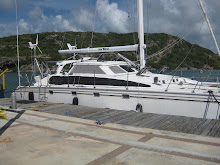
         Spanish Waters anchorage

Enjoying sundowners.                                              
                                                                          
      Sunset scene from our "front porch."

Yes, we're still here in Curacao. Who'd a thought???? Why are we still here? Weather and work. Or maybe I should say work and weather. We are having our mainsail and one of our trampolines mended. In addition, Mike has installed one new turbo on our starboard engine and cleaned the other. Major jobs! Many thanks to our recent visitors, the Dariens, for lugging the two turbos from Colorado. We also had our genoa rigged so that it will rollerfurl, which should make a wonderful improvement when sailing in light winds.


And it's Mardi Gras time.
Party boat with rockin' music.

           Mardi Gras decorations spring up at the dock.

As time has slipped by, our plans have changed. We had hoped to go west to Cartagena, Colombia, then on to the San Blas Islands. However, there just isn't enough time to enjoy that area and get out of the hurricane zone by July 1, as required by our insurance. Oh, well. Next year!


Meanwhile we are planning to head to Puerto Rico and the Dominican Republic. Of course, depending on the weather, we're not sure if we'll be able to go directly there or have to backtrack a bit then go up the island chain. Time will tell.


In the meantime, we're enjoying the cool weather here in Curacao. Because there is so much available in Curacao, we are taking advantage and frequently ride the bus into town ion search of goods. It is almost always a full day by the time we take our dinghy from the boat to the dinghy dock, wait for the bus—often late, walk many blocks to our destination, then ride the bus back to the bus station to board the bus for home. Of course, we often stop at a favorite local lunch spot called Plasa Bieu. It is a series of restaurants under one roof like the food courts in the U.S. That's where we had some delicious chicken satay, which Mike has been trying to replicate at home. We have also had a roti, a combination lunch of green beans, chicken, stewed meat, plantains, and salad placed on something like a tortilla. We sit at picnic benches covered with checkered vinyl cloths. The food is relatively inexpensive and delicious. Our favorite place in Plasa Bieu is called Gracias de Dios. After lunch we wait for the bus which sometimes comes and sometimes doesn't.--at least on time. The other day, for example, after rushing to get to the bus stop, the bus was over an hour late. Apparently the bus driver had had an accident, but of course, there's no replacement bus. By the time we get back from town, the day is usually over for any worthwhile work on the boat. In the evenings twice a week there's a happy hour at the local sailing club, Asiento. On other nights, we often have happy hour on others' boats or our own. Everyone takes their own drinks and a snack or dish to share. Lots of fun! Plus we make lots of new friends.

Here in Curacao, so many people are from other countries. Most speak English so we get by quite well.

We think a weather window might be coming up by the first of next week, so hopefully we'll be off.


Above are Esther, Baby Elmot, and Camille of Dutch S/V Al-Um.   They brought us homemade butterbiscuit, a Dutch shortbread, for  assisting them one night at 2 a.m.  They had come into Spanish Waters anchorage under sail hoping to get to their dock, but their engine would not start and they could not sail in.  They radioed for help realizing that maybe no one would hear their plea.  Fortunately, we did and were able to guide them safely to their slip.  


Wow! Wahoo for sale at fisherman's dock.


Fellow boater takes his dog for a "walk."


Wednesday, February 04, 2009

Curacao, December 23, 2008- Present


We have been in Curacao, the next island after Bonaire, since just before Christmas. It's another beautiful Dutch island in the West Indies. We anchored in an area called Spaanse Water—Spanish Waters. It's a very international community with many Dutch making this their home. We have met sailors from Germany, Australia, Tasmania, Sweden—the list goes on. One can get most anything here from boat parts to food to other supplies which is one reason it's such a popular place. Also there are competent people who can help diagnose and repair boats, a constant issue for boaters.

We celebrated Christmas and New Years with our good friends Jason and Karen on YOLO. Trying to get started on the boat issues was futile as most people were on holiday. We did, however, have one stroke of luck when we ventured to town riding various busses and walking distances between them—the usual routine--in search of “Carlos” who we learned could test our fuel injectors. Although the business looked closed, a walk to the back of the business turned him up, one of about three people working that day. He not only tested the equipment for us, but did it for free since no one was in the office to tell him the charge. A lucky day!!

On January 9th, our friends the Dariens from Marble, Colorado, arrived. We had rented a car from Imke, a fellow who does many things for yachties, by merely telling him our name and giving him $25. No paperwork. No need to show insurance or driver's license. Just the money and a promise to fill the tank to its present capacity. Oh, well. It worked for us.


This was Larry's and Dana 's third visit on the boat so they knew the drill. When the windy weather settled down, we sailed up the coast to Groot Knip. However, anchoring was not permitted there nor were there any mooring balls. (We had had to make a trip to the harbormaster to outline our travels and get permission to go where we intended. However, the harbormaster did not know about whether there were mooring balls in Groot Knip.) So back down the coast we went until we got to Santa Cruz—a lovely beach. Our YOLO friends joined us later on their way to Aruba. We all snorkeled a bit there and visited another nearby beach with a friendly little beach bar. A few days later we moved down to Santa Marta. Another pretty beach beckoned us, but we would have had to pay to use it. It was part of the resort there. We stayed a few days and were lucky enough to find a fisherman who gave us—yes, gave—us four Wahoo steaks. They were delicious. Despite our efforts to get fish, it has been relatively uncommon to find and be able to buy fresh fish. We learned that there are lots of fish 400-600 feet deep, but of course, we don't fish that deep so we don't catch any.
A return to Spanish Waters on Friday, January 23rd, allowed us to have dinner at the highly touted Equus restaurant. It's only open on Fridays! We all loved it—skewers of melt-in-your-mouth steak or chicken with garlic bread is the entire menu, of course, with wine or some other drink. We now knew why our friends insisted that it's one of the best restaurants in Curacao.
Before the Dariens left, we rented the car again and toured the island. True to the ABC climate,
the island is arid with lots of large cactus covering it. It too is a haven for flamingoes. We decided not to visit the normal tourist places and just enjoyed driving around the island.


The bananaquits are plentiful here and the oriole is the national bird.


The Dutch influence is charming and most prevalent in Willemstad, the capital, where old buildings are being restored and painted bright colors.


The Venezuelan floating market in Punda was a draw for its fresh, delicious vegetables.


Now, we are waiting for sail and engine repairs hoping to move on within the next couple of weeks.


Monday, December 22, 2008

Bonaire, December 15-23, 2008

After a 6 a.m. start, we arrived in Bonaire at about 2:30 p.m. On our way we celebrated leaving Venezuelan waters and an unusual time zone, ½ hour off of Atlantic Standard time--a Chavez thing.
Tom and Rose from Sojourn greeted us as we pulled up to the dreaded mooring buoy. It’s always a challenge to catch the loop on a mooring buoy with the boathook before the boat drifts over the buoy or away from it. But Tom and Rose held the loops (two in this case) for us making simple work of it! It’s nice to have friends!!
Though a tourist haven for scuba divers, Bonaire is a cute little Dutch island with the same crystal clear water we’ve been finding along the Venezuelan coast. Yes, this island is only 50 miles from the Venezuelan coast, but has ever so much more to offer. We are finding grocery stores that have the food we need. (In Venezuela, they were frequently out of cereal, coke, eggs, you name it!) Not so here. Because it’s small and touristy, prices are on the high side. So we will wait for Curacao, our next island, to do the badly needed stocking up.
We have enjoyed meeting our sailing buddies and, of course, snorkeling. Friday, we rented a car and toured the island which is very arid and sprouts cactus everywhere. There is a donkey sanctuary where old, hurt or orphaned donkeys are cared for. Donkeys were used greatly in the 1800s when workers carried loads of salt to and from the town. Bonaire produces great amounts


of salt and great mounds of salt are seen as one


drives around the southern part of the island. In the 1800s, slaves were brought over from Africa to work in the salt pans. They lived in the tiny huts pictured here and led a hard life until they were freed in 1863. (I am sitting in the tiny entryway of one of the huts that was often inhabited by 4 people!)


There were also beautiful pink flamingoes grazing in the shallow waters.
A highlight of our trip was a visit with s/v Pizazz, a couple from California, who, after sailing for 14 years, built their dream home in Bonaire. They had a lot of information to share on sailing to Colombia, our goal in January.

Las Aves--December 7-15


The next islands we visited, approximately 30 miles west of Los Roques, was Las Aves. These are two islands, Barlovento and Sotavento, that are beautiful with crystal clear water, great white sand beaches, and wonderful reefs to snorkel. We traveled not only with YOLO, but with some new friends, Tom and Rose on s/v Sojourn from Minneapolis, Minnesota. Their refrigeration had gone out so they divvied up their food between YOLO and us until we could reach Bonaire where hopefully they would be able to repair or replace their refrigerator.
We had been advised by some long-term sailors we met in Barlovento, Barry and Candy on s/v Syrius from Cape Town, South Africa, that the coast guard would check us in by radio in the Aves. Sure enough, as we rounded the corner into the Aves waters, we got a call asking us our name and our intentions. They were very nice and that was that, we thought. However, the next day we all got in our dinghies and went to a tiny island about a mile away where we were planning to snorkel. As we strolled around the island, we noticed a boat coming our way with six uniformed men aboard. They motioned to us. Sure enough, it was the coast guard and they wanted to do an inspection on each of our boats then. We quickly understood that we couldn’t do it later when we got back, so off we went back to our boats. It turned out that they indeed were very nice, but went through a long list checking off what we had aboard such as medical kit, flares, weapons (of course, none) etc. They went away happy.
Later that day we all got together on our boat for dinner and games! Tom is a big gamer so we played Sequence and Dominoes--Mexican Train, a very popular game with sailors. Though not our thing, we really did have a nice evening although the dinghy ride to and from was a wet one for YOLO and Sojourn.

Sojourn left a day ahead of us in order to get to Bonaire on a Saturday instead of a Sunday. The other four of us spent our time on Saturday, snorkeling looking for lobster and fish. Voila! Indeed we found them--i.e. Jason and Karen. Jason stalked a lobster and managed to spear it with his trident.


Karen speared a flounder and a grunt. That night we added our fresh catch to our dinner. Yum!

Saturday, December 20, 2008

Los Roques, November 13-December 7, 2008


Another night sail with YOLO and Riga II whom we met in Tortuga, and we were on to Los Roques….a gorgeous group of islands about 80 miles off the coast of Venezuela. This is a whole different Venezuela. Our friends from YOLO (Karen and Jason Trautz) are pictured above in the one beach bar we discovered on Francisquis, an island in Los Roques. The town on the island of Gran Roque is a charming village with streets of sand. Lots of Venezuelans come to relax and enjoy the beaches so there are many party boats--large catamarans that carry pleasure-seeking tourists to and from the various islands. People on Gran Roque seemed laid back and friendly. We met a restaurant owner, Pedro, who spoke excellent English and gave us a lot of valuable information, such as when the “fruit boat” would be in. We were looking to supplement our provisions, but found there were not a lot of fresh fruits and vegetables to be had. Also, Venezuela has the cheapest diesel around so we wanted to fill our boats before leaving.
There were weather predictions for squally conditions so we moved to better holding, Francisquis, a nearby island. There we found a little beach bar which served delicious barracuda, snapper and tuna for lunch--and beer! The lobsters were huge, but expensive so we held out for a local lobsterman’s catch another day. While in Los Roques we sailed to several areas, Sebastopol, Noronsquis, Crasqui and Sarqui to name a few. Snorkeling at Sebastopol was a thrill with huge midnight blue parrotfish, triggerfish --even a barracuda lurking in the reef. In other places, there was large brain coral harboring colorful snappers and goatfish darting in and out of their little caves. We often found our anchor chain surrounded by a school of small squid. When approached, as expected, they sprayed us with ink.
Watching the brown pelicans dive-bomb their dinner was amazing. They perch on the water or on boats in groups then on some signal unbeknownst to us, they fly off in a formation and do a nose-dive one after the other into the waters close by! Usually they sit afterward gulping a fish down the hatch. The scene repeats itself time after time, especially at day’s end. Very entertaining.

Saturday, November 01, 2008

Angel Falls, Canaima National Park, Venezuela, October 21-24, 2008

A four-day trip to a remote area of Venezuela was an adventure not to be missed. It started with a four-hour bus trip from Puerto La Cruz to Ciudad Bolivar. There we saw a different Venezuela--cleaner, brighter and nicer. Instead of the hacienda on a 26-acre cattle ranch as promised in the tour literature, however, we stayed at a hotel near the airport. Not bad, but not great. We were to go to the Canaima National Park in a small plane. These planes only go in the morning, so we had to wait for the next morning.


Our plane ride the next morning provided thrilling views of the countryside--few roads, few communities, lots of green fields, and huge, rocky mesas and cliffs interspersed with rivers. Spectacular views of the several different falls indicated we were almost there. We arrived in time to do a little exploring in the camp before lunch. A stroll through the village revealed the Pemon Indians sitting outside their small concrete homes, preparing food and watching their young children. Older children, dressed in navy pants or skirts and white shirts or blouses, were in the school nearby. The village was attractive and for the most part well-maintained. There were several different clusters of different housing for visitors, obviously an important business. Residents were also busy at work building what we later learned was a high school auditorium.


After a walk on the beach , we returned to the dining area where we were served a grilled chicken lunch. Very tasty. We were introduced to our guide, Pedro, and then shown to our rooms, simple but adequate. At 2:30 we met Pedro for a short canoe ride and then a hike to Sapo Falls. The waterfall was beautiful. We were able to walk underneath the falls as well. Then back to the camp for dinner.

Sapo Falls


Thursday morning after a hearty breakfast of pancakes, eggs, meat and cheese, we met Pedro for the four-hour canoe trip up the Carrao river to Angel Falls. Pedro explained how the Indians make the wooden canoes by felling a tree, then burning the interior and spreading it while hot to make it wider. This process is repeated until the proper width is reached. With just six in our group, our canoe was capable of more speed and than some of the other groups’ and better able to “climb the rocks“, that is, cross the many rapids we encountered.

Our captain, a young Indian man, handled the canoe expertly with a 48-horsepower Yamaha engine. He took extra propellers as travel through the rapids in the shallow water cause lots of wear and tear on the props. And, in fact, midway, he changed the propeller. He also had a helper who rode on the bow of the canoe advising the captain with hand signals and, from time to time, helping steer the canoe with a large wooden paddle.

After arriving at our camp, we started on the hike to Angel Falls.


Pedro told us that although the thick jungle was difficult walking because of the tangle of exposed roots, we should take time to notice the forest. That was hard to do as we had to watch our footing closely. Halfway into the hike, it started to rain. With the rain and the heat, we were soaking wet inside and out. Two hours after trekking up some very steep, rocky paths, we were at the falls. We took only a few moments to enjoy the vista from our high perch in the clearing, then headed back down hoping to beat nightfall which comes early here. However, we didn’t make it and found ourselves trudging through the forest trying hard not to trip and fall or step in the muddy muck caused by the afternoon rain.


Thoroughly exhausted and ravenous, we arrived back at the camp at 6 p.m. eagerly awaiting our meal which we had seen cooking by the fire. Our local Indian hosts, were roasting chickens on a spit over a roaring fire. Served with some delicious rice and cole slaw, the meal was a welcome end to our day’s adventure. We happily collapsed into our hammocks equipped with extra blankets for the cold that descends in the wee hours.


In the morning, after a breakfast of fried eggs, arepas (a round, flat bread similar to a biscuit), ham and cheese and tang, we climbed into our canoe for the ride home. A stop at Happiness Falls was a welcome respite from the canoe. The water was cool and refreshing. In the afternoon, we flew back to Ciudad Bolivar, boarded the bus for the four-hour trip back to Puerto La Cruz. Definitely an exciting adventure for the six of us: Greg Heloskie (S/V VAMOOSE), Shellee Lister (S/V PREFERRED STOCK), Mike, Sue, Mike & Kim Buller S/V CHILD'S PLAY).