Saturday, November 01, 2008

Angel Falls, Canaima National Park, Venezuela, October 21-24, 2008

A four-day trip to a remote area of Venezuela was an adventure not to be missed. It started with a four-hour bus trip from Puerto La Cruz to Ciudad Bolivar. There we saw a different Venezuela--cleaner, brighter and nicer. Instead of the hacienda on a 26-acre cattle ranch as promised in the tour literature, however, we stayed at a hotel near the airport. Not bad, but not great. We were to go to the Canaima National Park in a small plane. These planes only go in the morning, so we had to wait for the next morning.


Our plane ride the next morning provided thrilling views of the countryside--few roads, few communities, lots of green fields, and huge, rocky mesas and cliffs interspersed with rivers. Spectacular views of the several different falls indicated we were almost there. We arrived in time to do a little exploring in the camp before lunch. A stroll through the village revealed the Pemon Indians sitting outside their small concrete homes, preparing food and watching their young children. Older children, dressed in navy pants or skirts and white shirts or blouses, were in the school nearby. The village was attractive and for the most part well-maintained. There were several different clusters of different housing for visitors, obviously an important business. Residents were also busy at work building what we later learned was a high school auditorium.


After a walk on the beach , we returned to the dining area where we were served a grilled chicken lunch. Very tasty. We were introduced to our guide, Pedro, and then shown to our rooms, simple but adequate. At 2:30 we met Pedro for a short canoe ride and then a hike to Sapo Falls. The waterfall was beautiful. We were able to walk underneath the falls as well. Then back to the camp for dinner.

Sapo Falls


Thursday morning after a hearty breakfast of pancakes, eggs, meat and cheese, we met Pedro for the four-hour canoe trip up the Carrao river to Angel Falls. Pedro explained how the Indians make the wooden canoes by felling a tree, then burning the interior and spreading it while hot to make it wider. This process is repeated until the proper width is reached. With just six in our group, our canoe was capable of more speed and than some of the other groups’ and better able to “climb the rocks“, that is, cross the many rapids we encountered.

Our captain, a young Indian man, handled the canoe expertly with a 48-horsepower Yamaha engine. He took extra propellers as travel through the rapids in the shallow water cause lots of wear and tear on the props. And, in fact, midway, he changed the propeller. He also had a helper who rode on the bow of the canoe advising the captain with hand signals and, from time to time, helping steer the canoe with a large wooden paddle.

After arriving at our camp, we started on the hike to Angel Falls.


Pedro told us that although the thick jungle was difficult walking because of the tangle of exposed roots, we should take time to notice the forest. That was hard to do as we had to watch our footing closely. Halfway into the hike, it started to rain. With the rain and the heat, we were soaking wet inside and out. Two hours after trekking up some very steep, rocky paths, we were at the falls. We took only a few moments to enjoy the vista from our high perch in the clearing, then headed back down hoping to beat nightfall which comes early here. However, we didn’t make it and found ourselves trudging through the forest trying hard not to trip and fall or step in the muddy muck caused by the afternoon rain.


Thoroughly exhausted and ravenous, we arrived back at the camp at 6 p.m. eagerly awaiting our meal which we had seen cooking by the fire. Our local Indian hosts, were roasting chickens on a spit over a roaring fire. Served with some delicious rice and cole slaw, the meal was a welcome end to our day’s adventure. We happily collapsed into our hammocks equipped with extra blankets for the cold that descends in the wee hours.


In the morning, after a breakfast of fried eggs, arepas (a round, flat bread similar to a biscuit), ham and cheese and tang, we climbed into our canoe for the ride home. A stop at Happiness Falls was a welcome respite from the canoe. The water was cool and refreshing. In the afternoon, we flew back to Ciudad Bolivar, boarded the bus for the four-hour trip back to Puerto La Cruz. Definitely an exciting adventure for the six of us: Greg Heloskie (S/V VAMOOSE), Shellee Lister (S/V PREFERRED STOCK), Mike, Sue, Mike & Kim Buller S/V CHILD'S PLAY).

Side trip to Mendoza and the Andes Mountains

The ski area in the Andes Mountains

View of the Andes

A parilla (restaurant) at the ski area


Vineyards at Familial ZucchardiWinery


The Stovers enjoy a fabulous multi-course meal at the Familial Zucchardi winery restaurant.


Lou and Mike enjoy coffee at the vineyard

Buenos Aires, More....


Wooden lancha on the El Tigre delta.

A day trip to the El Tigre delta started with riding the train from Buenos Aires for about an hour.  El Tigre is a resort town north of Buenos Aires.  The river is full of wooden boats just like the one pictured above.  Houses line the river that extends for miles.  The residents use these boats as transportation to and from the mainland.  Tourists can catch a ride as well.  

Dog walker in Palermo

Is this the real Mike????

Evita's mausoleum in the Recoleta Cemetery

One of the many elaborate mausoleums in Recoleta Cemetery

Dog walkers

Haberdasher assesses Mike as he tries a hat at Plaza Dorrego.

Tango dancers in the square at Plaza Dorrego.

Busker performs in Palermo.


Lots of beautiful buildings line Buenos Aires streets.

Buenos Aires, Aug. 4-28--Neighborhoods


Buenos Aires is a large city with a population of 3 million which expands to 12 million including the suburbs. It was settled primarily by the Italians and Spanish in the 1500s although many other nationalities, primarily Europeans emigrated to Buenos Aires thereafter. San Telmo is the oldest of the 48 barrios or neighborhoods and is where we rented a two-story apartment with a small rooftop garden. Like many homes, there were several doors for security. To enter, we first had to unlock the door from our street into an entryway. Then we unlocked a gate into a courtyard off of which were several apartments. Unlocking a third door--if you don’t have the outside shutters bolted shut--accessed the apartment. There was a small living room, dining room, kiitchen and bath on the first floor and two bedrooms with baths on the second floor. To reach the second floor, one had to climb a narrow, spiral iron staircase, which could be a little perilous with a suitcase or after a night of debauchery.
San Telmo is a charming community not unlike Greenwich Village. There are lots of apartment buildings, churches, bistros, and restaurants and parillas (pictured here)where grilled sausage sandwiches called choripan, are grilled while you wait.
Up and down the streets were also lots of antique shops, trendy clothing shops, and small grocery stores on every block.
(Mike enjoys shoe shopping in a trendy local shop.)
But one of the best things about the neighborhood was the wonderful market , the San Telmo Market, just a block away. It was a very old structure with stands chock full of fresh fruits and vegetables, fresh meats and baked goods, and booths of antique or used goods.


Another great feature of the San Telmo barrio was the square called Plaza Dorrego. There one could wander daily through many small booths of jewelry, art, antiques, clothing, handicrafts--any and every kind of ware one could imagine. And on Saturdays and Sundays, vendors from all over came to join the regulars expanding the market to several blocks. There were bands, musicians, buskers, mimes as well as tons of people milling about. In addition there was a cafĂ© in the middle of the square with white tablecloths and delightful waiters who served hors d’oeuvres, lunches or just drinks while plaza-goers watched a pair of professional tango dancers entertain the crowds.


Transportation was easy in Buenos Aires. The buses are numerous and frequent., though walking was our preferred method of getting around. We visited the posher neighborhood of Palermo, full of upscale apartments and trendy shops and restaurants. Ray and Lou stopped for a picture on one of the main streets in Palermo.
Another ritzy neighborhood, Recoleta, is the home of the famous Recoleta Cemetery. Recoleta Cemetery is a large area with row upon row of mausoleums where the rich and famous buried their loved ones. The mausoleums are mostly marble and granite with impressive carvings and sculptures adorning them.
A large tree-lined walkway from which many side paths lead make it an attractive place for tourists. One of its most famous “inhabitants” is Eva Peron.

Thursday, July 31, 2008

Travel to Buenos Aires, Argentina August 2-4, 2008


Buenos Aires was all we thought it would be and more. Getting there proved a bit of an adventure as do most things in Venezuela. Ten minutes before we left, our travel agent called to say our Brazilian flight on Varig Airlines had been cancelled, but the good news--he had re-booked us on Lan Airlines for the following day. Since we were scheduled to spend the night in Caracas for an early flight the next day, we decided to go on to Caracas thinking we'd see a little of the city since our new flight left 12 hours later. What we forgot was that it was Sunday and most things are closed on Sunday. In addition, our hotel was near the airport, and it was quite costly to taxi into downtown for a few hours, so we hung out near our hotel. We ventured into a casino, one of the few open places but discovered they were very cautious when allowing people in or out. For example, we were not allowed to take our water bottles in with us. Mike was frisked at the door to boot. The parking attendant called the front desk before we entered to tell him that the coast was clear. Translation: No one was lurking about to rush into the casino. Since it was beastly hot and humid outside, the cool air in the casino felt great and caused us to spend a little more time there. When we left about an hour later, the guards went through the same drill, checking to be sure no bad guys were lurking about.

Although the city was not particularly clean or pretty, we did find a pretty good restaurant. We were amazed however when our waitress dropped a lime as she was removing our dishes, she simply kicked it all the way out to the curb and into the gutter.

At the airport, while standing in line to check in, we learned that travelers in Venezuela pay (about $5) to have their bags wrapped in saran-like plastic to prevent rummaging by airport workers. So, we did so, feeling foolish, but again--it's Venezuela.

Our trip on LAN Airlines turned out to be wonderful. We were served a full hot meal with real utensils and wine.

We arrived in Buenos Aires the next morning after a brief layover in Santiago, Chile, at about 9 a.m. where we were met by Roberto, a taxi driver who is the nephew of a business friend of Lou's and Ray's, Mike's sister-in-law and brother. As our guidebook suggested, we changed some money at the bank as we left the airport rather than at one of the numerous change kiosks as the rates are much better--generally, three pesos for one dollar.

Lou and Ray had arrived Saturday and were already ensconced in our rented apartment --the entryway is pictured at left--in the San Telmo neighborhood of Buenos Aires. They had had a taste of the charming neighborhood and its plentiful cafes and bars and were ready to introduce us.
One of the favorites' is the historic El Federal Cafe pictured below.
The San Telmo Church below was a familiar site in the neighborhood too.


Tuesday, July 29, 2008

Puerto La Cruz, Venezuela July 7 - 31, 2008

After a July 4th barbecue on the beach in Porlamar, we headed out with two other boats, Coqui and Gaia, to Puerto La Cruz, Venezuela, our destination for the hurricane season. Since it was 80 miles from Margarita, we had to stop along the way in El Coche. We stayed there until Monday, July 7, as the marina where we're staying was closed on the weekend. We had a long trip to PLC


and although we did catch a fish, it didn't look like one we'd want to eat.


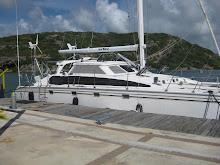
We arrived at our marina, TMO, at about 4 p.m., having started out at 5:30 a.m. The challenge was docking stern-to, that is, backing the boat into the dock, a feat we had not yet experienced and which most boaters shy away from. Yes, it was a challenge for us as well especially with a stiff breeze--the first of the day--off the starboard side. We finally succeeded but it was not easy!


Puerto La Cruz is a small, industrial port city. All of the marinas are located in this one area and all are secured by fences. It is not safe to travel outside the marinas except in groups, and even then, one must be careful. There is a large waterway with numerous canals off the entrance to the marinas. The homes are large and spacious; the condos line bridged canals in a Venice-like fashion. The area is known as El Morro.


Anuncio, Isla Margarita, June 28, 2008


Anxious to get the local experience, Mike and I decided to take a jaunt to the capital city of Margarita, Anuncio, about an hour away. Although we tried, we were unable to catch a bus at the marina and ended up walking for about an hour into town through some questionable areas. We stopped for lunch at a local restaurant. Fortunately it had air conditioning and supplied its clientelle with real knives and forks--not the plastic cutlery that is used in the streetside fast food restaurants that proliferate in Margarita. We were anxious to try some local food. Mike had a delicious chicken dish and I an arepa (a-ray'-pa), a flat, disc-like biscuit about the size of a hamburger bun, often filled with a stuffing of meat, chicken or fish. This was unfilled and a bit plain. Anyhow, we proceeded in search of the bus station, another 20-minute walk in the hot, hot sun. Finally we found a bus heading for Anuncio and hopped on.


An hour later we found ourselves in a charming old city, much cleaner and neater than Porlamar. However, since it was Saturday afternoon, most shops and restaurants were closed. We walked on the square, an ever-present structure in most Latin American cities. There was the requisite statue of the South American hero, Simon Bolivar. We later learned that his statue is featured in all central squares in different poses representing different events.


After finally finding a place for a cold drink, we caught the bus back to town. The buses are all in bad repair, but the fare is very cheap, about 30 cents to go most places in the city. The fare to Anuncio, cost us about 50 cents each, each way.


Finding our bus back to the marina was an exhausting affair. No one we asked had a clue. We were directed around the square in Porlamar whose streets were packed with weekend shoppers. (Porlamar is a destination for Venezuelan--an island with beaches, palm trees and duty-free goods.) To preserve our sense of humor, we ducked occasionally into the ice cold shops which poured air conditioning onto the jam-packed, sizzling streets. Finally, we hailed a taxi. Nevertheless, it was good to see the bustling city, buy some limes from a street vendor who also threw in a banana for each of us, and visit a quieter, more stately city.